Thursday, April 26, 2007
DotNetNuke - A Free and Open Source Framework!!!
At last, a reason for me to run a Microsoft server for web applications. I might start on this very soon!

Fun with Attribute Based Programming – Extending Enumerations
Amazing article on using attributes in C#. Attributes can simplify some parts of generic programming tasks such as expanding enumerations like in the article above. The code for the article can be found here.
State-Driven Game Agent Design
A very good article on state machines, the code is in C++ but you can find a similar version for C# at Codecube.net.
Wednesday, April 25, 2007
Video Lectures From World's Leading And Prominent Scientists.
This link is a nice find so far, I have not watched any of the videos because I have been really busy.
Tuesday, April 24, 2007
Haha, They put a warning on the back of pirating the product....
Its too funny, the movie studios really need to watch there networks and products.. There never going to be able to secure there products anymore.... They just do not understand technology.
Monday, April 23, 2007
Anti-Patterns
http://en.wikipedia.org/wiki/Anti-pattern
One of my favorite ones is "Smoke and mirrors: Demonstrating how unimplemented functions will appear"
One of my favorite ones is "Smoke and mirrors: Demonstrating how unimplemented functions will appear"
Wednesday, March 28, 2007
CoilOsapien Killer!

The killer robot of choice by 9 out of 10 Americans. I got to get my self one of these bad boys to build a self defence system in my house.
Using LINQ to solve puzzles
The Puzzle
Here's a puzzle similar to the one in the puzzle hunt. The diagram below is a bunch of weights (A-M) hanging from a system of bars. Each weight has an integer value between 1 and 13, and the goal is to figure out what each weight must be for the the diagram below to balance correctly as shown:
                          |
                        |
            +--+--+--+--+--+--+--+
            |                    |
            |                    |
         +--+--+--+--+--+        |
         |     L        M        |
         |                       |
+--+--+--+--+--+--+     +--+--+--+--+--+
H              |  I     |  J        K  |
               |        |              |
      +--+--+--+--+--+  |     +--+--+--+--+--+
      E              F  |     G              |
                        |                    |
            +--+--+--+--+--+  +--+--+--+--+--+--+
            A              B  C                 D
The rules for this kind of puzzle are: (1) The weights on either side of a given pivot point must be equal, when weighted by the distance from the pivot, and (2) a bar hanging beneath another contributes it's total weight as through it were a single weight. For instance, the bar on the bottom right must have 5*C=D, and the one above it must have 3*G=2*(C+D).
I think there approach is way too brute force, this it seems like a little set theory mixed in with some linear algebra and recursive decent would be able to solve this problem. More on it later, if I come up with my own solution.
Thursday, March 22, 2007
Thread with a buch of carpc software.


A fun sunday installing a pc in my car... Forget the cell phone drivers next are the pc drivers!!!
Monday, March 19, 2007
WPF Demo by Laurent Bugnion
The basic concepts you need to start working with wpf. Embed media into your button!!!!
Friday, March 16, 2007
Wednesday, March 14, 2007
Get-WmiObject for finding products installed.
Quick snipit:
PS> Get-WmiObject -class "Win32_Product" -namespace "root\cimv2" -computername THECOMPUTER -filter "Name='Some Silly Product'"
PS> Get-WmiObject -class "Win32_Product" -namespace "root\cimv2" -computername THECOMPUTER -filter "Name='Some Silly Product'"
Monday, March 12, 2007
PocketPC 2003 is so kind to me.


What kind of error messages are these? Do I want to loose my data because my data is corrupted? My bluetooth licence has expired? What else my phone is ready to explode or be tossed out of my car window on the highway!!!
Sunday, March 04, 2007

Saturday, March 03, 2007
Sierpinski Triangle in C# with a WPF Polygon.

Simple wpf app to create a small Sierpinski Triangle... This is just a base of something I would like to create, so this is a start of using the Sierpinski Triangle. Algorithm came from the wikipedia implementation in java.
Monday, February 26, 2007

Advanced Unit Testing, Part I - Overview
A very nice long artical on unit testing... I'm still very impressed by the Agile Principles, Patterns, and Practices in C# as a reference...
Wednesday, December 20, 2006
Vista and Speech Recognition
When I get Vista installed and have some extra time, I would like to create an application that can recognize what news sites I would want to read and open them in IE or firefox. This doesnt seem to hard just takes a little time.
Saturday, November 25, 2006
Old Art.

I found some old photography art I did of my ex-girlfriend from years ago. I wounder what she's up too now. I put this girl through hell, my life was a little crazy at that time.
Saturday, November 11, 2006
ipsuid gets a blog!
I have been trying to get ipsuid to blog, and here it is. His hardware knowledge is amazing and he's always got a project brewing or working. It's also funny since I give him stuff I dont use any more and he turns it into something. One example was a monitor I had, I think he powers a lazor with it or something.
Friday, November 10, 2006
It has been late nights.

Work has been keeping me up late, or I just like working at odd hours. Desk at 3 a.m.
Thursday, November 09, 2006
Microsoft does not even know its own file extensions
The .ps1 is what people have been using for monard aka PowerShell aka who knows what other names. But I found it funny that microsofts website does not redirect you to the main site for PowerShell.
They also dont under stand msh
They also dont under stand msh
Tuesday, November 07, 2006

Saturday, November 04, 2006
Some Fun Math and Puzzle Sites
http://qbyte.org/
http://qbyte.org/puzzles/
http://www.mathpuzzle.com/
http://www.artofproblemsolving.com/
http://qbyte.org/puzzles/
http://www.mathpuzzle.com/
http://www.artofproblemsolving.com/
Thursday, November 02, 2006

Monday, October 30, 2006
Lost Art Work

This is an oil painting of a street that I have stuck in my head. I have no idea where this street is since its an image from when I was a kid, one of those images that you never forget but also never know where they come from. This painting I and showed a dear friend of mine who loved it. So I just gave them the painting and I know they enjoy it.
Friday, October 27, 2006
Fun Math Facts.
I have to say my fav fact is the multiplication by 11.
Let b1, b2, .... , bn be the digits of a number, then
b1*11 = b_1b_1
b1b2*11=b1(b1+b2)b2
b1b2b3*11=b1(b1+b2)(b2+b3)b3
[...]
b1b2...bn*11=b1(b2+b3)....(bn-1 + bn)bn
This "fun fact" could be proved by induction.

Let b1, b2, .... , bn be the digits of a number, then
b1*11 = b_1b_1
b1b2*11=b1(b1+b2)b2
b1b2b3*11=b1(b1+b2)(b2+b3)b3
[...]
b1b2...bn*11=b1(b2+b3)....(bn-1 + bn)bn
This "fun fact" could be proved by induction.
Wednesday, October 25, 2006

Monday, October 23, 2006
Googlism
While looking for scripts colorize python code into html I stumbled to googlism! You cant find xsignal on it just yet. But give it time. I also found the script I was looking for http://aspn.activestate.com/ASPN/Cookbook/Python/Recipe/52298/index_txt
Vector Fun
Here is a simple program to help you find the magnitude, dot product,
cross product of 2 vectors of size 3, and the projection vectors of each.
This is nothing ground breaking, but it shows you how fast you can code
something like this up in python with out much work. Some sample output:
+-+-+-+-+-+-+-+-+-+-+-+-+-+-+-+-+-+-+-+-+-+-
Enter in vector x: (separated by spaces)
Enter in vector y: (separated by spaces)
--------------------------------------------
ERROR: vectors entered are not the same size
--------------------------------------------
Vectors entered:
x = < 1 , 1 , 1 , 1 >
y = < -1 , 1 , -1 >
Magnitude of x is sqrt(4)=2.0
Magnitude of y is sqrt(3)=1.73205080757
Enter another pair of vectors [y/n]?
+-+-+-+-+-+-+-+-+-+-+-+-+-+-+-+-+-+-+-+-+-+-
Enter in vector x: (separated by spaces)
Enter in vector y: (separated by spaces)
Vectors entered:
x = < 3 , 2 , 1 >
y = < -1 , -2 , 4 >
Magnitude of x is sqrt(14)=3.74165738677
Magnitude of y is sqrt(21)=4.58257569496
Dot product of x and y is -3
The angle between x and y (in degrees) is: 1.74666507689
The cross product of x and y:
x cross y = < 10 , -13 , -4 >
The projection of y onto x:
proj_x(y) = < -9/14 , -3/7 , -3/14 >
The projection of x onto y:
proj_y(x) = < 1/7 , 2/7 , -4/7 >
Enter another pair of vectors [y/n]?
+-+-+-+-+-+-+-+-+-+-+-+-+-+-+-+-+-+-+-+-+-+-
Enter in vector x: (separated by spaces)
Enter in vector y: (separated by spaces)
Vectors entered:
x = < 0 , 1 >
y = < -1 , 0 >
Magnitude of x is sqrt(1)=1.0
Magnitude of y is sqrt(1)=1.0
Dot product of x and y is 0
The angle between x and y (in degrees) is: 1.57079632679
The projection of y onto x:
proj_x(y) = < 0 , 0 >
The projection of x onto y:
proj_y(x) = < 0 , 0 >
Enter another pair of vectors [y/n]?
+-+-+-+-+-+-+-+-+-+-+-+-+-+-+-+-+-+-+-+-+-+-
Enter in vector x: (separated by spaces)
Enter in vector y: (separated by spaces)
--------------------------------------------
ERROR: vectors entered are not the same size
--------------------------------------------
Vectors entered:
x = < 1 , 1 , 1 >
y = < -1 , 1 >
Magnitude of x is sqrt(3)=1.73205080757
Magnitude of y is sqrt(2)=1.41421356237
Enter another pair of vectors [y/n]?
+-+-+-+-+-+-+-+-+-+-+-+-+-+-+-+-+-+-+-+-+-+-
Enter in vector x: (separated by spaces)
Enter in vector y: (separated by spaces)
Vectors entered:
x = < 1 , 1 , 1 , 1 , 1 >
y = < -1 , 1 , -1 , 1 , -1 >
Magnitude of x is sqrt(5)=2.2360679775
Magnitude of y is sqrt(5)=2.2360679775
Dot product of x and y is -1
The angle between x and y (in degrees) is: 1.77215424759
The projection of y onto x:
proj_x(y) = < -1/5 , -1/5 , -1/5 , -1/5 , -1/5 >
The projection of x onto y:
proj_y(x) = < 1/5 , -1/5 , 1/5 , -1/5 , 1/5 >
Enter another pair of vectors [y/n]?
You did not enter a y/n so we exit anyways.
cross product of 2 vectors of size 3, and the projection vectors of each.
This is nothing ground breaking, but it shows you how fast you can code
something like this up in python with out much work. Some sample output:
+-+-+-+-+-+-+-+-+-+-+-+-+-+-+-+-+-+-+-+-+-+-
Enter in vector x: (separated by spaces)
Enter in vector y: (separated by spaces)
--------------------------------------------
ERROR: vectors entered are not the same size
--------------------------------------------
Vectors entered:
x = < 1 , 1 , 1 , 1 >
y = < -1 , 1 , -1 >
Magnitude of x is sqrt(4)=2.0
Magnitude of y is sqrt(3)=1.73205080757
Enter another pair of vectors [y/n]?
+-+-+-+-+-+-+-+-+-+-+-+-+-+-+-+-+-+-+-+-+-+-
Enter in vector x: (separated by spaces)
Enter in vector y: (separated by spaces)
Vectors entered:
x = < 3 , 2 , 1 >
y = < -1 , -2 , 4 >
Magnitude of x is sqrt(14)=3.74165738677
Magnitude of y is sqrt(21)=4.58257569496
Dot product of x and y is -3
The angle between x and y (in degrees) is: 1.74666507689
The cross product of x and y:
x cross y = < 10 , -13 , -4 >
The projection of y onto x:
proj_x(y) = < -9/14 , -3/7 , -3/14 >
The projection of x onto y:
proj_y(x) = < 1/7 , 2/7 , -4/7 >
Enter another pair of vectors [y/n]?
+-+-+-+-+-+-+-+-+-+-+-+-+-+-+-+-+-+-+-+-+-+-
Enter in vector x: (separated by spaces)
Enter in vector y: (separated by spaces)
Vectors entered:
x = < 0 , 1 >
y = < -1 , 0 >
Magnitude of x is sqrt(1)=1.0
Magnitude of y is sqrt(1)=1.0
Dot product of x and y is 0
The angle between x and y (in degrees) is: 1.57079632679
The projection of y onto x:
proj_x(y) = < 0 , 0 >
The projection of x onto y:
proj_y(x) = < 0 , 0 >
Enter another pair of vectors [y/n]?
+-+-+-+-+-+-+-+-+-+-+-+-+-+-+-+-+-+-+-+-+-+-
Enter in vector x: (separated by spaces)
Enter in vector y: (separated by spaces)
--------------------------------------------
ERROR: vectors entered are not the same size
--------------------------------------------
Vectors entered:
x = < 1 , 1 , 1 >
y = < -1 , 1 >
Magnitude of x is sqrt(3)=1.73205080757
Magnitude of y is sqrt(2)=1.41421356237
Enter another pair of vectors [y/n]?
+-+-+-+-+-+-+-+-+-+-+-+-+-+-+-+-+-+-+-+-+-+-
Enter in vector x: (separated by spaces)
Enter in vector y: (separated by spaces)
Vectors entered:
x = < 1 , 1 , 1 , 1 , 1 >
y = < -1 , 1 , -1 , 1 , -1 >
Magnitude of x is sqrt(5)=2.2360679775
Magnitude of y is sqrt(5)=2.2360679775
Dot product of x and y is -1
The angle between x and y (in degrees) is: 1.77215424759
The projection of y onto x:
proj_x(y) = < -1/5 , -1/5 , -1/5 , -1/5 , -1/5 >
The projection of x onto y:
proj_y(x) = < 1/5 , -1/5 , 1/5 , -1/5 , 1/5 >
Enter another pair of vectors [y/n]?
You did not enter a y/n so we exit anyways.
Wednesday, October 18, 2006

![torusknot[a_, b_, c_][p_, q_][t_] := { (a + b Cos[q t]) Cos[p t], (a + b Cos[q t]) Sin[p t], c Sin[q t]}](http://xsignal.mindtunnel.org/MATH/TorusKnot/HTMLFiles/index_2.gif)
![ParametricPlot3D[torusknot[10, 4, 5][100, 1.5][t] // Evaluate, {t, 0, 120π}, PlotPoints→200 , ViewPoint→ {20, 30, 70}] ; //Timing](http://xsignal.mindtunnel.org/MATH/TorusKnot/HTMLFiles/index_3.gif)
![[Graphics:HTMLFiles/index_4.gif]](http://xsignal.mindtunnel.org/MATH/TorusKnot/HTMLFiles/index_4.gif)

![ParametricPlot3D[torusknot[10, 4, 5][100, 1.5][t] // Evaluate, {t, 0, 1π}, PlotPoints→200 , ViewPoint→ {20, 30, 70}] ; //Timing](http://xsignal.mindtunnel.org/MATH/TorusKnot/HTMLFiles/index_6.gif)
![[Graphics:HTMLFiles/index_7.gif]](http://xsignal.mindtunnel.org/MATH/TorusKnot/HTMLFiles/index_7.gif)

![ParametricPlot3D[torusknot[10, 4, 5][100, 1.5][t] // Evaluate, {t, 0, 1π}, PlotPoints→100 , ViewPoint→ {20, 30, 70}] ; //Timing](http://xsignal.mindtunnel.org/MATH/TorusKnot/HTMLFiles/index_9.gif)
![[Graphics:HTMLFiles/index_10.gif]](http://xsignal.mindtunnel.org/MATH/TorusKnot/HTMLFiles/index_10.gif)

![ParametricPlot3D[torusknot[10, 4, 5][100, 4π][t] // Evaluate, {t, 0, 1π}, PlotPoints→100 , ViewPoint→ {20, 30, 70}] ; //Timing](http://xsignal.mindtunnel.org/MATH/TorusKnot/HTMLFiles/index_12.gif)
![[Graphics:HTMLFiles/index_13.gif]](http://xsignal.mindtunnel.org/MATH/TorusKnot/HTMLFiles/index_13.gif)

![ParametricPlot3D[torusknot[100, 34π, 52][1003, 433π][t] // Evaluate, {t, 0, 10000π}, PlotPoints→100 , ViewPoint→ {20, 30, 70}] ; //Timing](http://xsignal.mindtunnel.org/MATH/TorusKnot/HTMLFiles/index_15.gif)
![[Graphics:HTMLFiles/index_16.gif]](http://xsignal.mindtunnel.org/MATH/TorusKnot/HTMLFiles/index_16.gif)

![torusknot[a_, b_, c_][p_, q_][t_] := { (a + b Cos[q t]) Cos[p t], (a + b Cos[q t]) Sin[p t], c Sin[q t]} ;](http://xsignal.mindtunnel.org/MATH/TorusKnot/HTMLFiles/index_18.gif)
![ParametricPlot3D[torusknot[u, 3, 5][3, u][t], {t, 0, 3}, {u, 0, 3}]](http://xsignal.mindtunnel.org/MATH/TorusKnot/HTMLFiles/index_19.gif)
![[Graphics:HTMLFiles/index_20.gif]](http://xsignal.mindtunnel.org/MATH/TorusKnot/HTMLFiles/index_20.gif)


![[Graphics:HTMLFiles/index_23.gif]](http://xsignal.mindtunnel.org/MATH/TorusKnot/HTMLFiles/index_23.gif)

Friday, October 13, 2006
Monday, October 09, 2006
Chaos: Fractal Basin Boundaries

Chaos always makes nice background images for your desktop systems. This is my current image:
Basin boundaries arise in dissipative dynamical systems when two, or more, attractors are present. In such situations each attractor has a basin of initial conditions which lead asymptotically to that attractor. The basin boundaries are the sets which separate different basins. It is very common for basin boundaries to contain unstable chaotic sets. In such cases the basin boundaries can have very complicated fractal structure. Because of this complicated very fine-scaled structure, fractal basin boundaries can pose an impediment to predicting long-term behavior. In particular, if an initial condition is specified with only finite precision, it may be very difficult a priori to determine in which basin it lies if the boundaries are fractal.
Google Code Searching For Coding Bugs.
This is just one simple search for common terms that might be linked to secuirty flaws.
Sunday, October 08, 2006
Matrix Fun
A simple program written in python that does matrix addition,
multiplication, scalar multiplication,
transpose and put the matrix into reduced echelon form.
The main driver program is matrix_fun.py
which does the matrix operations. The run_gen.sh is a
bash script that runs the program gen_random_test_file.py.
gen_random_test_file.py generates a flat text file based on the command line parameters given to it.
python gen_random_test_file.py - h
USAGE : gen_random_test_file.py[options]
Simple program to generate a test file with
random variables for size, min, max and scalar
options : -sm M, --sizemin = M Rows of matrix (random selection of 1 <>-sM N, --sizemax = N Cols of matrix (random selection of 1 <>-m X, --min = N Minimum value of a random element in the matcies
-M Y, --max = Y Maximum value of a random element in the matcies
-cm C, --scalarmin = C Minimum value for a scalar
-cM B, --scalarmax Maximum value for a scalar
-l L, --length = L Length of the list to generate
-f FILENAME, --filename = FILENAME Filename to write list too.
Then the script runs the matrix_fun.py program against it and outputs the results to a text file. Just check the code out its very simple to follow with no real thought about who the user is. Here is an example of just running matrix_fun.py by its self:
what are the dimensions of matrix A [mxn]:
3x3
Please enter in matrix A one row at a time separated by spaces.
1 2 3
5 6 7
4 5 6
What is the dimensions of your matrix B [mxn]:
3x3
Please enter in matrix B one row at a time separated by spaces.
5 6 3
7 5 2
7 9 2
MATRIX A:
| 1 2 3 |
| 5 6 7 |
| 4 5 6 |
MATRIX B:
| 5 6 3 |
| 7 5 2 |
| 7 9 2 |
If Matrix A and B are both mxn we can add them.
We can add Matrix A and B
A + B =
| 6 8 6 |
| 12 11 9 |
| 11 14 8 |
Please enter a scalar value to multiply matrix A by, (cA)
5
| 5 10 15 |
| 25 30 35 |
| 20 25 30 |
Finding the transpose of A:
| 1 5 4 |
| 2 6 5 |
| 3 7 6 |
Matrix Multiplication (AB)
| 40 43 13 |
| 116 123 41 |
| 97 103 34 |
Putting Matrix A into Reduced echelon form.
Before rref:
| 1 2 3 |
| 5 6 7 |
| 4 5 6 |
Row 0 times -5 added to row 1
| 1 2 3 |
| 0 -4 -8 |
| 4 5 6 |
Row 0 times -4 added to row 2
| 1 2 3 |
| 0 -4 -8 |
| 0 -3 -6 |
Row 1 divided by -4
| 1 2 3 |
| 0 1 2 |
| 0 -3 -6 |
Row 1 times -2 added to row 0
| 1 0 -1 |
| 0 1 2 |
| 0 -3 -6 |
Row 1 times 3 added to row 2
| 1 0 -1 |
| 0 1 2 |
| 0 0 0 |
Would you like to enter another matrix [y/n]
multiplication, scalar multiplication,
transpose and put the matrix into reduced echelon form.
The main driver program is matrix_fun.py
which does the matrix operations. The run_gen.sh is a
bash script that runs the program gen_random_test_file.py.
gen_random_test_file.py generates a flat text file based on the command line parameters given to it.
python gen_random_test_file.py - h
USAGE : gen_random_test_file.py[options]
Simple program to generate a test file with
random variables for size, min, max and scalar
options : -sm M, --sizemin = M Rows of matrix (random selection of 1 <>-sM N, --sizemax = N Cols of matrix (random selection of 1 <>-m X, --min = N Minimum value of a random element in the matcies
-M Y, --max = Y Maximum value of a random element in the matcies
-cm C, --scalarmin = C Minimum value for a scalar
-cM B, --scalarmax Maximum value for a scalar
-l L, --length = L Length of the list to generate
-f FILENAME, --filename = FILENAME Filename to write list too.
Then the script runs the matrix_fun.py program against it and outputs the results to a text file. Just check the code out its very simple to follow with no real thought about who the user is. Here is an example of just running matrix_fun.py by its self:
what are the dimensions of matrix A [mxn]:
3x3
Please enter in matrix A one row at a time separated by spaces.
1 2 3
5 6 7
4 5 6
What is the dimensions of your matrix B [mxn]:
3x3
Please enter in matrix B one row at a time separated by spaces.
5 6 3
7 5 2
7 9 2
MATRIX A:
| 1 2 3 |
| 5 6 7 |
| 4 5 6 |
MATRIX B:
| 5 6 3 |
| 7 5 2 |
| 7 9 2 |
If Matrix A and B are both mxn we can add them.
We can add Matrix A and B
A + B =
| 6 8 6 |
| 12 11 9 |
| 11 14 8 |
Please enter a scalar value to multiply matrix A by, (cA)
5
| 5 10 15 |
| 25 30 35 |
| 20 25 30 |
Finding the transpose of A:
| 1 5 4 |
| 2 6 5 |
| 3 7 6 |
Matrix Multiplication (AB)
| 40 43 13 |
| 116 123 41 |
| 97 103 34 |
Putting Matrix A into Reduced echelon form.
Before rref:
| 1 2 3 |
| 5 6 7 |
| 4 5 6 |
Row 0 times -5 added to row 1
| 1 2 3 |
| 0 -4 -8 |
| 4 5 6 |
Row 0 times -4 added to row 2
| 1 2 3 |
| 0 -4 -8 |
| 0 -3 -6 |
Row 1 divided by -4
| 1 2 3 |
| 0 1 2 |
| 0 -3 -6 |
Row 1 times -2 added to row 0
| 1 0 -1 |
| 0 1 2 |
| 0 -3 -6 |
Row 1 times 3 added to row 2
| 1 0 -1 |
| 0 1 2 |
| 0 0 0 |
Would you like to enter another matrix [y/n]
Friday, October 06, 2006
Nice Electronic Dictionary
This embedded electronic dictionary can do and say anything. The most impressive support to me is the English to Arabic and Arabic to English support. The only problem I would have with this device is I would open it up before I would even use it! I would also like to know what TTS software if any, that they use for there device.
Wednesday, October 04, 2006
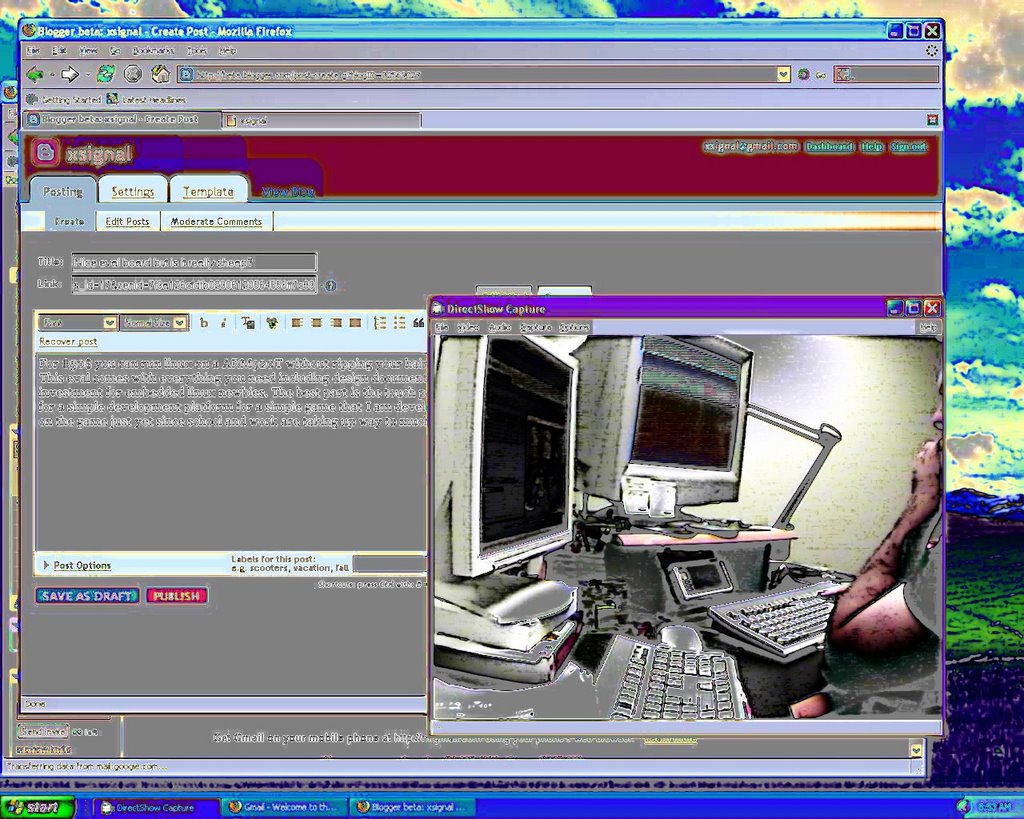


Nice eval board but is it really cheap?
For 850$ you can run linux on a ARM920T without ripping your hair out trying to get it to work. This eval comes with everything you need including design documents, it could be a good investment for embedded linux newbies. The best part is the touch panel. Currently I am looking for a simple development platform for a simple game that I am developing on the side. No details on the game just yet since school and work are taking up way to much time!
Ahmadinejad and the Holocaust
What the Holocaust demonstrates is the danger of a one-party state. It shows what can happen when a group of true believers, convinced of the superiority of their own ideas, have unchecked power. They are then free to rewrite history to suit their political ends, and crush those who disagree or protest . . . or who worship God in a different way.
Like, say, the mullahs in Iran.
Saturday, September 30, 2006
Great python statistics info site.
There was some graphing module I used once for work, but I dont remember the name of it. When I go back to work I will find out.
Saturday, September 16, 2006
Ahoy, mateys ! Thar be Jewish pirates!
One such pirate was Moses Cohen Henriques, who helped plan one of history's largest heists against Spain. In 1628, Henriques set sail with Dutch West India Co. Admiral Piet Hein, whose own hatred of Spain was fueled by four years spent as a galley slave aboard a Spanish ship. Henriques and Hein boarded Spanish ships off Cuba and seized shipments of New World gold and silver worth in today's dollars about the same as Disney's total box office for "Dead Man's Chest."
Tuesday, September 12, 2006
israeli and jewish music feed for your podcasts collection.
The only problem is the mp3 files are a little large, but hey its worth the space.
Monday, September 11, 2006
"Usually, trust values that a kernel-mode component gives you."
You have to love that qoute from that book. TRUST THE WINDOWS KERNEL!@#!@#
Subscribe to:
Posts (Atom)